

What Long Road hauls on the RGN
The RGN carries loads that are too tall or too heavy for a flatbed or stepdeck. Because the gooseneck comes off, the deck rides low to the ground, which lowers the load's center of gravity and keeps a tall piece under permit height. Drivable machinery drives on and off under its own power, so loading stays fast and safe with the equipment on the ground the whole time.
This is the trailer Long Road reaches for on heavy haul and oversize moves. Excavators, tractors, and other earthmoving machinery roll straight on. Industrial components, plant equipment, and out-of-gauge cargo ride on the low deck with secure tie-down. When a piece drives, the RGN loads it without any lifting gear at the pickup or the drop.
Call (425) 800-4609 for the tallest, heaviest machinery on Long Road's mechanical and hydraulic RGN trailers, loaded by ramp with no crane.
Get a Quote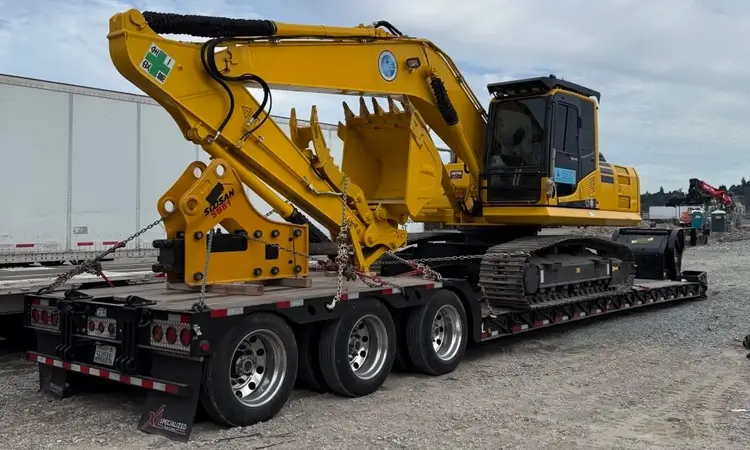
The two RGN trailers Long Road runs
Long Road owns two RGN types, so the trailer is matched to the height and weight of your load. Both run a 53-foot deck.
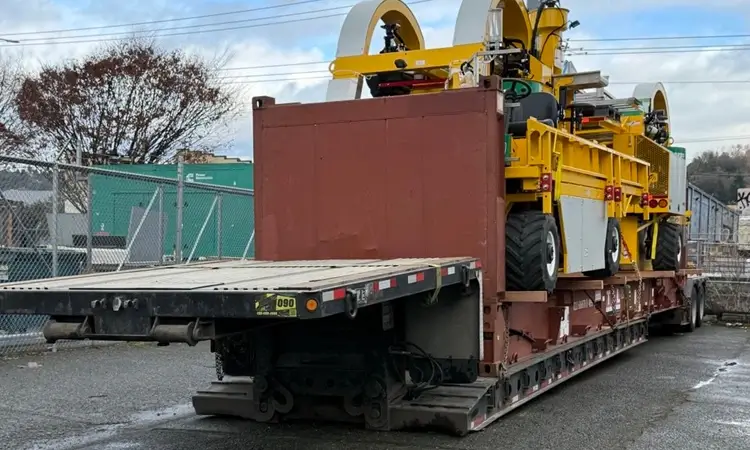
Mechanical RGN (lowboy)
The mechanical RGN, known here as the lowboy, has a 53-foot deck at 1 foot 7 inches of deck height and weighs 15,000 lbs. Its low profile suits tall machinery that needs every inch of clearance to stay under permit height. The lighter frame leaves more room for payload while the load rides close to the ground.
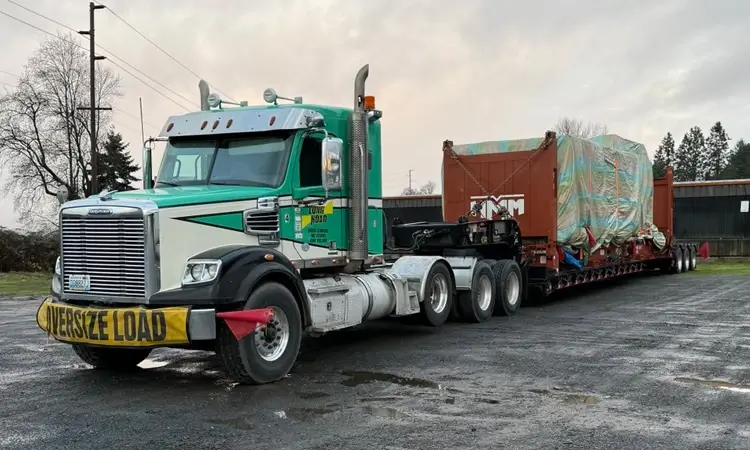
Hydraulic RGN
The hydraulic RGN runs a 53-foot deck with a lower deck height of 2 feet and weighs 31,000 lbs. The hydraulic gooseneck raises and lowers the deck under power for a smooth roll-on, roll-off. That makes it the more versatile of the two, handling a wider range of heavy, drive-on loads across construction, energy, and industrial work.
RGN trailer dimensions and specifications
These are the two trailers Long Road actually runs, side by side with the ranges you will meet elsewhere in the market. Deck height is the number that decides whether a tall piece needs a permit, so it is the first figure to check against your load.
| Figure | Long Road mechanical RGN (lowboy) |
Long Road hydraulic RGN | Typical market range |
|---|---|---|---|
| Overall deck length | 53 ft | 53 ft | 48–53 ft |
| Loaded deck height | 1 ft 7 in | 2 ft 0 in | 1 ft 6 in – 2 ft 0 in |
| Trailer tare weight | 15,000 lbs | 31,000 lbs | 15,000–35,000 lbs |
| Gooseneck | Mechanical, detaches | Hydraulic, powered raise & lower | Mechanical or hydraulic |
| Loading method | Drive-on by ramp | Drive-on by ramp | Drive-on; crane only if the piece does not roll |
| Legal width without permit | 8 ft 6 in | 8 ft 6 in | |
| Legal height without permit | 13 ft 6 in (14 ft 0 in in much of the West) | 13 ft 6 in – 14 ft 0 in | |
| Legal gross combination weight | 80,000 lbs | 80,000 lbs | |
Working out your payload before you call
Payload on an RGN is not a fixed number, it is what is left over. The arithmetic is simply:
80,000 lbs gross − tractor weight − trailer tare = legal payload
With a day-cab tractor in the region of 18,000 lbs, the mechanical RGN leaves roughly 47,000 lbs of legal payload and the hydraulic RGN roughly 31,000 lbs. Those are worked examples, not a quote: the tractor assigned to your move and the axle spacing both shift the number, and anything above the legal gross needs an overweight permit rather than a different trailer. Send us the actual weight and we will run it against the tractor that will pull it.
RGN vs lowboy vs step deck vs double drop
These four names get used interchangeably and they are not the same trailer. The difference that matters is how low the deck sits and whether the machine can roll onto it under its own power.
| Trailer | Deck height | Max freight height before a permit | Loads without a crane? |
|---|---|---|---|
| RGN | ≈ 1 ft 6 in – 2 ft | ≈ 11 ft 6 in – 12 ft | Yes — the neck comes off and it drives on |
| Lowboy (fixed neck) | ≈ 1 ft 6 in – 2 ft | ≈ 11 ft 6 in – 12 ft | No — the load has to be lifted into the well |
| Double drop | ≈ 1 ft 6 in – 2 ft | ≈ 11 ft 6 in – 12 ft | No — fixed neck, crane into the well |
| Step deck (drop deck) | ≈ 3 ft 6 in | ≈ 10 ft | Ramps only, and only for lighter machines |
| Flatbed | ≈ 5 ft | ≈ 8 ft 6 in | No — forklift or crane |
Read the table from the bottom up and the logic is straightforward. A flatbed is the cheapest trailer on the road and the right answer whenever the freight fits under about 8 ft 6 in. A step deck buys you roughly another eighteen inches of height for very little extra cost. Below that, once the piece is over ten feet tall or heavy enough that it must not be lifted, you are into low-deck territory — and there the only question left is whether it can drive.
That last question is the whole argument for the RGN. A lowboy with a fixed neck and a double drop both put the deck just as low, but the load has to come in from above, which means a crane at the pickup and a second crane at the delivery. On an RGN the gooseneck detaches, the front of the deck rests on the ground, ramps go down, and an excavator or a tractor simply drives on. Two crane calls disappear from the bill and from the schedule.
Extendable (stretch) RGN — when the load is long, not just heavy
A standard RGN deck runs around 29 feet. Plenty of freight is heavier than a step deck can take and also longer than 29 feet — bridge beams, wind blades, long tanks, pipe, structural steel, crane booms. That is what an extendable RGN is for: the deck pulls apart on rails so the load is supported at both ends instead of overhanging.
Two things worth knowing before you assume stretching solves it. Payload falls as the deck extends, because the same axles now carry a longer lever — a trailer rated for 80,000 lbs closed does not carry 80,000 lbs stretched. And an extended trailer is longer overall, which usually pushes the move into a length permit and often into escort requirements it would not have needed closed.
Send the length and the weight together. Either one alone cannot tell you whether the load stretches, needs more axles, or has to be broken down.
Axles: the number that decides whether it is legal
Almost every "is this too heavy" question is really an axle question. Federal bridge rules limit weight per axle and per axle group, not just gross — which is why two loads of identical weight can be one legal and one not, depending entirely on how the trailer spreads it.
A standard RGN in a 3-axle configuration handles most machinery inside normal permit limits. Add axles — jeeps ahead of the trailer, boosters behind it — and the same trailer carries substantially more, legally, because the weight spreads over more ground. Each added axle also adds length, cost and permit complexity, so the right answer is the fewest axles that make the load legal, not the most.
For overweight containers the equivalent answer is a 3, 4 or 5-axle superchassis rather than an RGN — the box stays on a chassis and the axles do the work.
How an RGN load actually runs
1. Measure honestly. Operating weight, and transport dimensions with attachments removed. Spec-sheet numbers are usually optimistic and are the most common cause of a truck arriving that cannot take the load.
2. Pick the trailer. Deck height, deck length, axle count. This is the decision that sets both the permit and the price.
3. Permit the route, not the load. Washington permits a specific route. Bridges, overpasses and weight-restricted structures decide it, and the shortest line on a map is frequently not permittable.
4. Detach and drop. At pickup the gooseneck detaches and the deck lowers to the ground, forming a ramp. Tracked and wheeled machinery drives on under its own power — no crane, no ramps to rent, no lifting equipment at either end.
5. Secure and go. Chains and binders rated to the load, with escorts and curfews where the permit requires them.
What an RGN move costs
There is no per-mile rate for heavy haul, and a carrier who quotes you one is rounding in their own favour. The number is built from the trailer and axle configuration, permit fees in each jurisdiction crossed, pilot cars where dimensions require them, the route the permit allows rather than the one the map suggests, loading and unloading at both ends, and any curfew or night-move restriction that adds a day.
Multi-state and cross-border moves take longer to arrange than to drive, because every jurisdiction issues its own permit. Send dimensions, weight and both addresses, and you get a real number rather than a range — see heavy haul trucking.
Frequently asked
What is an RGN trailer?
RGN stands for removable gooseneck. The gooseneck is the front section that connects the trailer to the tractor, and on an RGN it detaches and is set down, which lets the front of the deck drop to ground level and form a ramp. That is the single feature that separates an RGN from every other low-deck trailer: drivable machinery loads itself, with no lifting equipment at either end.
How tall a load can an RGN carry?
With a deck sitting around 1 ft 6 in to 2 ft off the road, an RGN typically carries a piece up to roughly 11 ft 6 in to 12 ft tall while staying inside the 13 ft 6 in legal height most states use, or the 14 ft allowed across much of the West. Anything taller is still movable, but it becomes a permitted oversize move with a routed survey and, above certain heights, pilot cars.
What is the difference between an RGN and a lowboy?
In everyday use the words overlap, and plenty of carriers call the same trailer both. The distinction that actually changes your move is the neck: a true RGN has a gooseneck that comes off so the load drives on, while a fixed-neck lowboy keeps its neck attached and has to be loaded from above. If your machine rolls, the RGN saves you the crane. Long Road calls its mechanical RGN the lowboy for exactly this reason — it is a removable-neck trailer used the lowboy way.
When is a step deck the better choice?
Whenever the load fits. A step deck sits about three and a half feet up and carries freight to roughly ten feet tall, it is lighter, cheaper and far easier to route than a low-deck trailer, and it does not usually need a permit. Reach for an RGN when the height, the weight or the need to drive the piece on rules a step deck out — not before.
Do I need a permit for an RGN load?
Not automatically. An RGN load that stays within 8 ft 6 in wide, under the legal height and inside 80,000 lbs gross moves on ordinary authority. Cross any one of those lines and the move needs a state permit, and in Washington that also means checking the route for bridge and height restrictions before the truck is dispatched. We handle the permitting as part of the move; see oversize and heavy haul for how that runs.
What is an extendable or stretch RGN?
An RGN whose deck pulls apart on rails to carry loads longer than a standard 29-foot deck. Payload drops as it extends, and the extra overall length usually brings a length permit with it.
How many axles does my load need?
The fewest that make it legal. Federal bridge rules limit weight per axle group, so spreading the load over more axles — jeeps and boosters — raises what moves legally. More axles also mean more length, more permit and more cost, so it is a calculation rather than a default.
How much does it cost to ship on an RGN?
Per move, not per mile: trailer and axle configuration, permits in every jurisdiction crossed, pilot cars if required, the permitted route, and loading at both ends. Send dimensions, weight and both addresses for a firm number.
Do you own your RGNs or broker them?
We own them. That is the difference between a confirmed date and a hopeful one — an RGN is not interchangeable with a dry van, so when a broker's promised trailer falls through there is rarely a substitute sitting nearby.
Move your heavy load with Long Road
When the piece is too tall or too heavy for a standard trailer, Long Road matches it to the right RGN, plans the route, and gets it there safely. Call (425) 800-4609 or request a quote with your dimensions and weight to get started.
- 2020 Asset-based since
- 200+ Private chassis & equipment
- 2 PNW ports, every terminal
- 3-acre Tacoma yard & depot
- 24/7 Capacity & repair shop
Call (425) 800-4609 with your dimensions and weight, and Long Road matches your load to the right RGN.
Get a Quote